

PrivateGPT
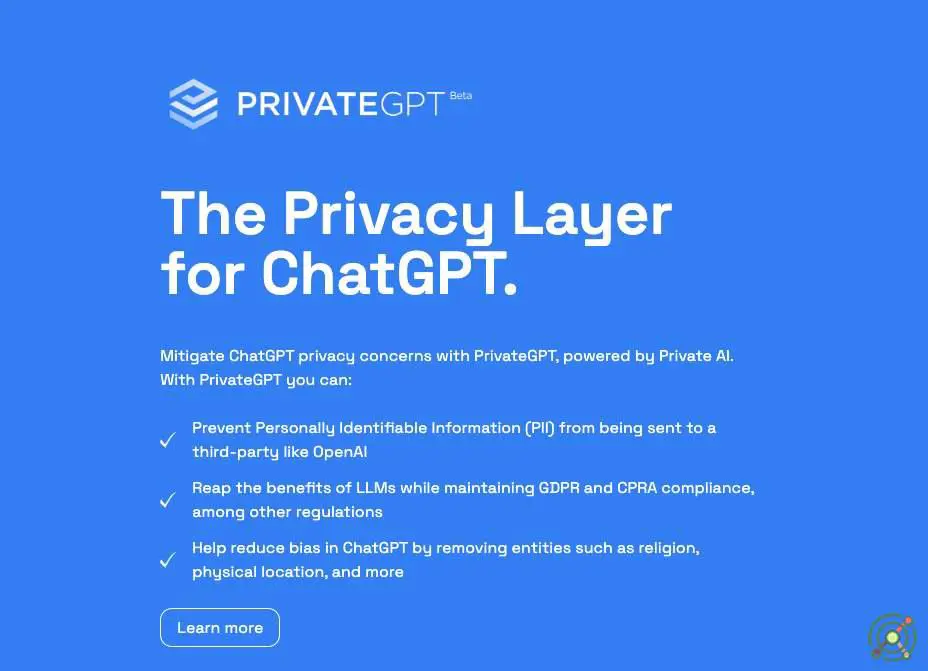
A privacy-focused AI solution that enables secure interactions with generative AI models by redacting personal information from user prompts.
PrivateGPT
A privacy-focused AI solution that enables secure interactions with generative AI models by redacting personal information from user prompts.

YouTube Video: PrivateGPT
A privacy-focused AI solution that enables secure interactions with generative AI models by redacting personal information from user prompts.
PrivateGPT
SKU: privategpt
PrivateGPT is designed to facilitate secure and private interactions with generative AI models like OpenAI's ChatGPT. It functions by removing over 50 types of Personally Identifiable Information (PII) from user inputs before processing them through AI models, ensuring that sensitive data is not exposed or retained. After processing, PrivateGPT reintegrates the redacted information into the AI's responses, providing a seamless user experience without compromising privacy. This approach allows organizations to leverage the capabilities of generative AI while maintaining compliance with data privacy regulations and protecting user data.
Organizations seeking to utilize generative AI tools without risking exposure of sensitive data.
Developers aiming to integrate privacy-preserving AI interactions into their applications.
Businesses needing to comply with data privacy regulations while employing AI technologies.
Users desiring secure and private AI-driven assistance for tasks like document review and report generation.
PrivateGPT demonstrates high autonomy due to its ability to operate locally on enterprise servers with no external data transmission, ensuring full data control. It integrates with existing authentication systems (Kerberos, SAML, OIDC) and supports offline document processing via embedded models like LlamaCPP. However, its autonomy is partially dependent on external LLM providers like Azure OpenAI for advanced tasks, though this can be configured for fully local operation using open-source models.
Closed Source
Paid